
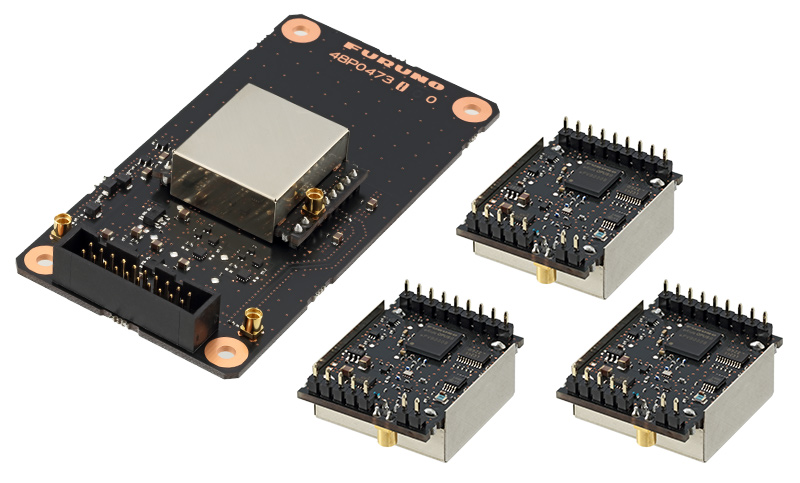
- GNSS for Time Sync
Model
GF-102/103/104/105G
- NEW
Built to defend against diverse GNSS threats.
With L1/L5 dual-band reception and five lines of defense, the GF-100 Series helps protect timing performance against multipath, satellite anomalies, jamming, and spoofing.
When a threat is detected, Proactive Holdover keeps timing output stable.
*Planned launch: November 2026
- GNSS (Timing, Automotive/Industrial)
Features
High-Stability Frequency and Accurate Time Pulse in a Single Module
The GF-100 Series offers a range of Dual-Band GNSS Disciplined Oscillators that integrate a Dual-Band GNSS receiver, a high-precision oscillator and control circuitry into a single module.
They output an accurate time pulse (1PPS) synchronized to UTC as well as a highly stable reference frequency (10 MHz). By simply integrating them into your system, you can achieve high-quality time synchronization with built-in countermeasures against GNSS vulnerabilities.
Based on Furuno’s expertise as a GNSS receiver manufacturer, the GF-100 Series features a proprietary design that eliminates the need for an external CPU. This helps reduce design workload and shorten time to market.
L1/L5 Dual-Band Reception — Beyond Single-Band
Our legacy GF-880x Series has delivered high timing accuracy using the L1 band. The GF-100 Series now supports dual-band with the addition of the L5 band.
By receiving two frequency bands simultaneously, the GF-100 Series corrects propagation delays caused by the ionosphere, further improving time accuracy.
The GF-100 Series supports multi-GNSS reception, including GPS (L1 + L5), Galileo (E1 + E5), Beidou (B1I /B1C, B2a), NavIC (L5) and QZSS (L1 + L5). By utilizing signals from multiple satellite systems, it helps improve reception stability in a wide range of operating environments.
For details on the role of the L5 band in countermeasures against GNSS vulnerabilities, please refer to the Defense-in-Depth section.
Defense in Depth — Five Lines of Defense for GNSS Reception
The use of GNSS-based time synchronization is increasing year by year across a wide range of systems, including professional radio systems, broadcasting, data centers, private 5G networks, and critical infrastructure.
At the same time, threats such as multipath, jamming, and spoofing have become real-world concerns. Simply “receiving GNSS signals” is no longer enough to ensure reliability.
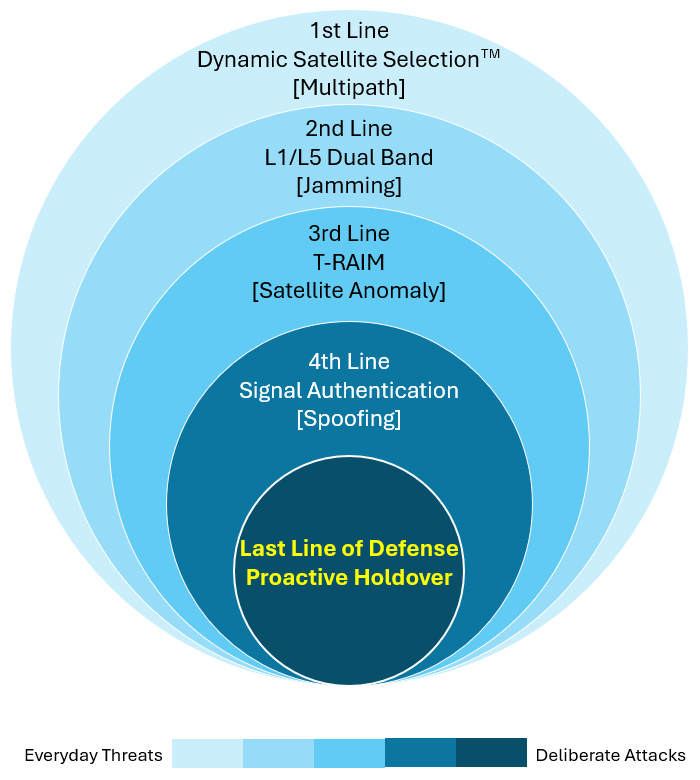
The GF-100 Series adopts a Defense in Depth approach, providing multi-layered protection against a wide range of threats to GNSS reception — from everyday degradation of the receiving environment to deliberate interference.
Four shields plus a last line of defense ensure protection and continuous, precise time synchronization.
The following is an overview of each line of defense.
For further details, please refer to the technical white paper.
In urban areas, near windows, and other environments where multipath is likely to occur, reflected GNSS signals can degrade time accuracy.
The GF-100 Series features Dynamic Satellite Selection™*, which evaluates the quality of received satellite signals in real time and dynamically selects satellites with higher signal quality. This helps minimize degradation in timing performance, even in challenging reception environments.
- Anti-multipath technology based on an algorithm developed by NTT.
The L1 band of GNSS signals — 1575.42 MHz — is widely used, but it is also a common target for jamming interference.
The GF-100 Series adopts a dual-band design that receives not only L1 but also L5 — 1176.45 MHz. It also supports fully independent L5 search, allowing satellites to be acquired using the L5 band alone, without relying on L1. Even if the L1 band is affected by jamming, the GF-100 Series can continue time synchronization using L5.
The GF-100 Series also includes a function to detect and monitor the frequency and level of jamming signals, helping support root-cause analysis.
Satellite signal quality can deteriorate for various reasons, including satellite malfunctions, atmospheric anomalies, and residual reflected signals. If low-quality signals are used without proper evaluation, time synchronization accuracy may be degraded.
The GF-100 Series features T-RAIM — Timing Receiver Autonomous Integrity Monitoring. It continuously evaluates the reliability of received satellite signals and automatically excludes abnormal signals that are inconsistent with other observations. By using only valid satellite signals, the GF-100 Series ensures accurate time synchronization.
Malicious spoofing signals can intentionally mislead the time calculated by a GNSS receiver.
The GF-100 Series supports Galileo OSNMA — Open Service Navigation Message Authentication — and QZSS QZNMA. Authentication information transmitted by GNSS satellites is used to verify the authenticity of received navigation messages. Satellites identified as anomalous through authentication are automatically excluded from timing calculations, reducing the impact of spoofing.
Even in the unlikely event that a threat passes through all four defense lines described above, the GF-100 Series keeps precise time output running.
When the GF-100 Series detects the effects of jamming or spoofing on all bands, Proactive Holdover automatically disengages from GNSS signals and switches to holdover using the built-in oscillator.
This is fundamentally different from conventional holdover. Conventional holdover typically starts running only after GNSS reception is lost. In contrast, Proactive Holdover actively disengages from GNSS when abnormal conditions are detected.
Furuno’s proprietary oscillator control technology predicts and compensates for oscillator behavior. The GF-105G achieves holdover performance of ±1.5 µs over 24 hours.
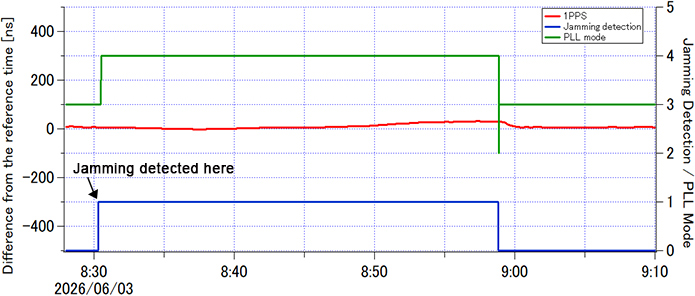
Proactive Holdover
Compact Design Compatible with the GF-880x Series
The GF-100 Series ensures hardware compatibility with the GF-880x Series across all models. It can replace existing products without requiring changes to board layout or connector placement.
The GF-100 Series lineup includes the Short form factor (GF-102 / GF-103 / GF-104) for applications that prioritize compact size, and the Grande form factor (GF-105G) for direct replacement of the GF-8804/8805. Customers can choose the model that best fits their design requirements.
The GF-104 in the GF-100 Series achieves holdover performance of ±2.5 µs over 24 hours in a Short form factor measuring 34 × 27 × 15.5 mm. It combines a compact mounting footprint with high timekeeping performance.
Product Lineup — Four Models for Different Applications
The GF-100 Series includes four models with different holdover performance levels and form factors. GNSS vulnerability countermeasures, including Defense in Depth, are common across all models. Customers can select the optimal model according to system requirements.
These models provide the core functions of the GF-100 Series, including Defense in Depth, at a lower cost. They are suitable for systems deployed over wide areas in large numbers, such as professional radio base stations and private 5G networks.
Model | Form Factor | Holdover (24h) | Key Features |
GF-102 | Short (34×27×15.5mm) | < ±20µs | Balanced essential performance and cost efficiency |
GF-103 | Short (34×27×15.5mm) | < ±5µs | A standard model for a wide range of applications |
These models offer high holdover performance and are suitable for critical infrastructure applications that require high timing accuracy and robustness, including telecommunications, power utilities, finance, and broadcasting. Customers can select the optimal model according to their mounting requirements and required holdover performance.
Model | Form Factor | Holdover (24h) | Key Features |
GF-104 | Short (34×27×15.5mm) | < ±2.5µs | Compact design with high holdover performance |
GF-105G | Grande (100×52×14.1mm) | < ±1.5µs | Ideal for direct replacement of the GF-8804/8805, with sine-wave output |
Model | Form Factor | 1PPS Accuracy (Locked) | Holdover (24h) | 10 MHz Short-Term Stability (Root Allan Variance, τ = 1s) | Size (mm) |
GF-102 | Short | < ±40ns | < ±20µs | < 5×10⁻¹¹ | 34×27×15.5 |
GF-103 | Short | < ±40ns | < ±5µs | < 2×10⁻¹¹ | 34×27×15.5 |
GF-104 | Short | < ±40ns | < ±2.5µs | < 1×10⁻¹¹ | 34×27×15.5 |
GF-105G | Grande | < ±40ns | < ±1.5µs | < 1×10⁻¹¹ | 100×52×14.1 |
Phase Relationship between Frequency and Time Pulse
The phase relationship between the frequency output and time pulse output is always constant — coherent and jitter-free.
Output with Only One Satellite
The GF-100 Series can output frequency and time pulse signals while tracking only one satellite, excluding mobile positioning mode.
Synchronization to External Pulse
The receiver can synchronize with an externally supplied time pulse. By using a time pulse output from an IEEE 1588-compliant network synchronization device or similar equipment, the system can incorporate a redundant time source.
Maximizing Performance with the Recommended Antenna
Antenna selection is also important to fully utilize the Defense-in-Depth performance of the GF-100 Series.
The AU-500 is a time synchronization antenna supporting L1/L5 dual-band GNSS reception. With high noise immunity and IP67-rated environmental resistance, it enables full use of the dual-band reception capability of the GF-100 Series.
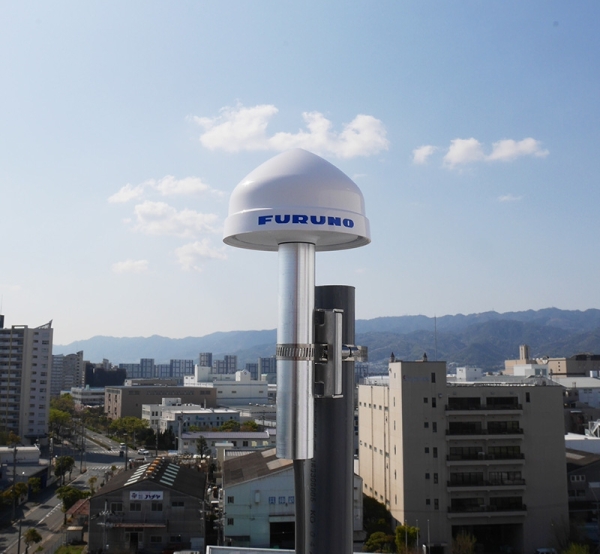
Jammer Test Participation — Robustness Verified in Real-World Environments
The Defense-in-Depth capability of the GF-100 Series has been developed not only based on catalog specifications, but also through verification in real-world jamming and spoofing environments.
Since 2024, FURUNO has continuously participated in an international GNSS vulnerability testing event held in Andøya, Norway.
At this event, GNSS receiver resilience is tested in an environment where actual jamming and spoofing signals are transmitted.
In September 2026, the GF-100 Series underwent real-world testing at an event. The series operated as expected under jamming and spoofing conditions, confirming the effectiveness of its Defense in Depth design.
Insights gained through previous test participation have been fed back into the Defense-in-Depth design of the GF-100 Series. Design based on threat patterns confirmed in real-world environments supports the robustness of the GF-100 Series.

Specifications
General
GPS L1C/A, GLONASS L1OF, Galileo E1B/E1C,BeiDou B1I /B1C, QZSS L1C/A, SBAS L1C/A
GPS L5, Galileo E5a, BeiDou B2a, QZSS L5, NavIC L5
62 channels
Acquisition: >= -148 dBm
Tracking: >= -163 dBm
*Measurement environment using GNSS simulator
Compliant with G.8272 PRTC-A and PRTC-B
*Compliant with TDEV (Time Deviation) /MTIE (Max Time Interval Error)
< 5 minutes (until lock state)
Square pulse
Sine wave (GF-105G only)
GF-102
10MHz Long Term Stability (24h average): < ± 1 × 10⁻¹²
10MHz Short Term Stability (Root Allan variance ( =1s)): < 5 × 10⁻¹¹
GF-103
10MHz Long Term Stability (24h average): < ± 1 × 10⁻¹²
10MHz Short Term Stability (Root Allan variance ( =1s)): < 2 × 10⁻¹¹
GF-104/105G
10MHz Long Term Stability (24h average): < ± 1 × 10⁻¹²
10MHz Short Term Stability (Root Allan variance ( =1s)): < 1 × 10⁻¹¹
1PPS Accuracy: < ± 40ns (vs UTC)
1PPS Stability: < 4.5ns(1 σ)
*Open sky
GF-102
10MHz Long Term Stability (24h average): < ± 1 × 10⁻⁹
10MHz Short Term Stability (Root Allan variance ( =1s)): < 5 × 10⁻¹¹
GF-103
10MHz Long Term Stability (24h average): < ± 2 × 10⁻¹⁰
10MHz Short Term Stability (Root Allan variance ( =1s)): < 2 × 10⁻¹¹
GF-104/105G
10MHz Long Term Stability (24h average): < ± 3 × 10⁻¹¹
10MHz Short Term Stability (Root Allan variance ( =1s)): < 1 × 10⁻¹¹
GF-102
1PPS Accuracy: < ± 20μs/24h
GF-103
1PPS Accuracy: < ± 5μs/24h
GF-104
1PPS Accuracy: < ± 2.5μs/24h
GF-105G
1PPS Accuracy: < ± 1.5μs/24h
GF-102/103/104
3.7VDC
GF-105G
5.5VDC
GF-102/103/104
200 mA (Typ)
GF-105G
170 mA (Typ)
-40°C to +85°C
Short and Open Detection
GF-102/103/104
34mm × 27mm × 15.5mm
GF-105G
100mm × 52mm × 14.1mm
PFEC (NMEA 0183 Standard Ver 4.30)
Anti-Jamming, Multipath Mitigation (Dynamic Satellite Selection™), Anti-Spoofing, Holdover, T-RAIM, Antenna Detection Circuit, TAI output
Evaluation Kit
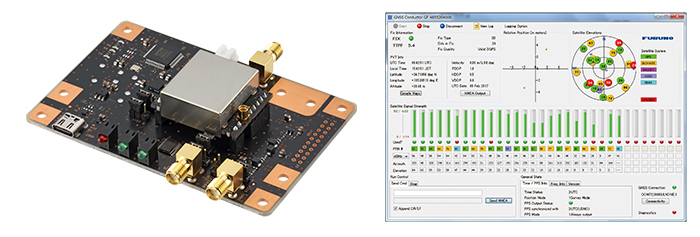
(In Preparation)
Output time pulse (1PPS) and 10 MHz reference frequency (selectable) from a SMA terminal.
Simple use by connecting the GNSS antenna and power supply
Connect a PC with a USB port to communicate with the kit.
Accessories: GNSS Antenna
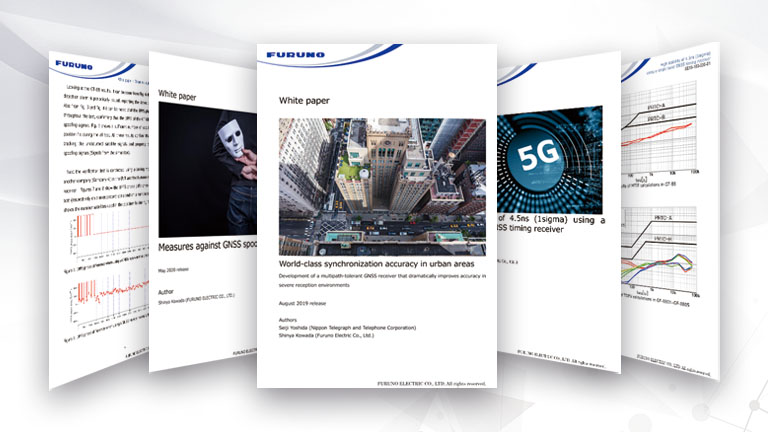
White Papers
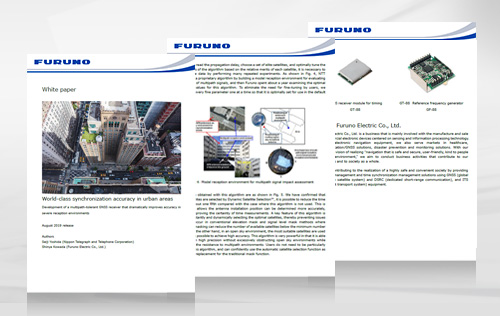
Countermeasure for GNSS receiver failure
Our engineer specializing in time synchronization explains, with charts and diagrams, the countermeasures to be taken on the receiver side against typical GNSS-related problems such as “multipath, "jamming", "spoofing", and interruption of GNSS signal reception, the degree of effectiveness, and how to select a GNSS product.
If this is your first time considering a GNSS receiver, please have a look through these papers.
You can download all five together with the white paper “High Stability of 4.5ns (1 sigma) using a single band GNSS timing receiver”.
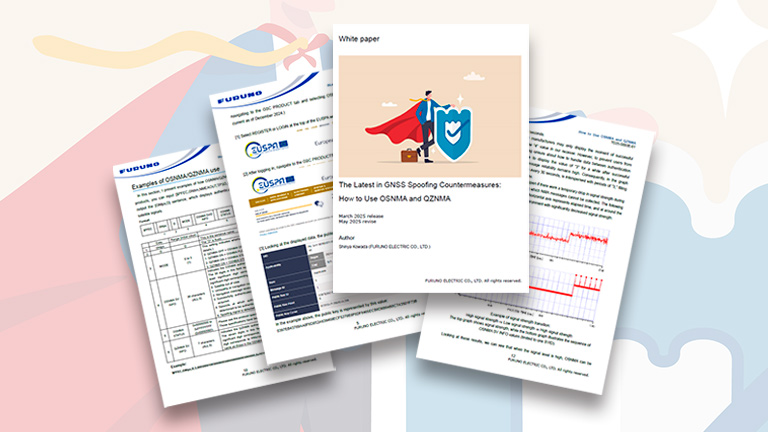
The Latest in GNSS Spoofing Countermeasures: How to Use OSNMA and QZNMA
In this white paper, a FURUNO engineer specializing in GNSS timing explains how OSNMA and QZNMA should be used in real-world applications, with practical insights provided in about 20 pages.
"What GNSS spoofing is and why it matters today"
"Key concepts of OSNMA and QZNMA"
"Operational considerations"
"How to use authentication functions in FURUNO GNSS receivers"
Quote Request

This is a quote form only for GNSS receivers for time synchronization.
For other contents, please contact us using the respective inquiry form.
Inquiries about GNSS Products
- Specifications subject to change without notice.
GNSS for Time Sync Product List
Model
GT-100
Model
GT-90/GT-9001
Model
RCB-100
Model
GF-102/103/104/105G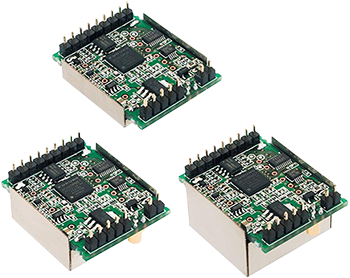
Model
GF-8801/02/03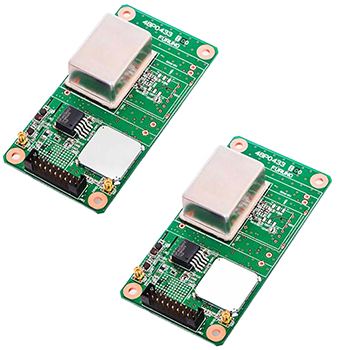
Model
GF-8804/05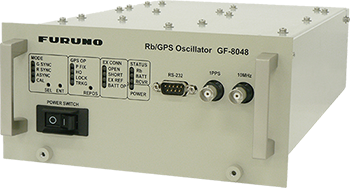
Model
GF-8048
Model
TB-1